Primates


Primates include lemurs, monkeys, apes (and humans).  The early ancestors probably looked like present day Tree Shrews to be seen in the Forest House.

The development of the 'opposable thumb' which allows the hand to grip objects, is thought to be a characteristic which has helped primates advance their position in evolutionary development.  Surprisingly perhaps, a few monkeys including the Javan Brown Langur have shown a trend towards a reduction in thumb length.

This may be for under tree limb movement when thumbs would be in the way for reaching and grasping the next branch.

Another adaption, which helps facilitate digestion, is an expansive stomach to allow for the fermentation by bacteria of their specialised diet of leaves.  They also have the ability to deal with plan toxins that would kill other monkeys.

Langur

Langur


Gibbons and Siamang

Gibbons and Siamang are termed 'lesser apes', because they are smaller than the better known 'great apes';  Orang-utans of S.E. Asia, Gorillas and Chimpanzees of Africa.

Gibbons live in the tropical forests of Southeast Asia.  Long arms and 'hooked' hands are used for swinging (or brachiating) from branch to branch.  Loud calls often duets, which may be heard here serve to maintain pair bonds and exclude neighbouring groups by calling 'territory occupied'

Lar Gibbon
White-handed or Lar Gibbon

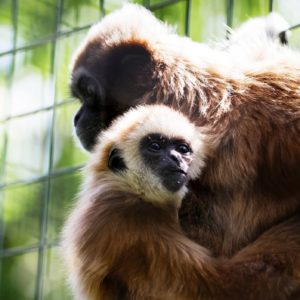
Siamang mother and baby

Siamang calling
Siamang calling


Sulawesi Crested Macaque

Vistors observing Macaque

These tail-less macques from Indonesia are true monkeys. Much of their food is found on the ground.  They live in extended family groups with one adult male in charge.

The macaques forest habitat is being taken to grow crops.  They are therefore seen as pests by local people and are hunted as 'bushmeat'.  Captive breeding programmes exist because they are a threatened species with a limited range.

This group breeds well.  Visitors are able to gain much from watching fellow primate natural behaviours.

'See no evil'
'See no evil'

'Hear no evil'
'Hear no evil'

'Speak no evil'
'Speak no evil'


Previous Page

Thrigby Hall Wildlife Gardens, Filby, Great Yarmouth, Norfolk, NR29 3DR

Tel: +44 (0)1493 369477 Fax: +44 (0)1493 368256

Next Page